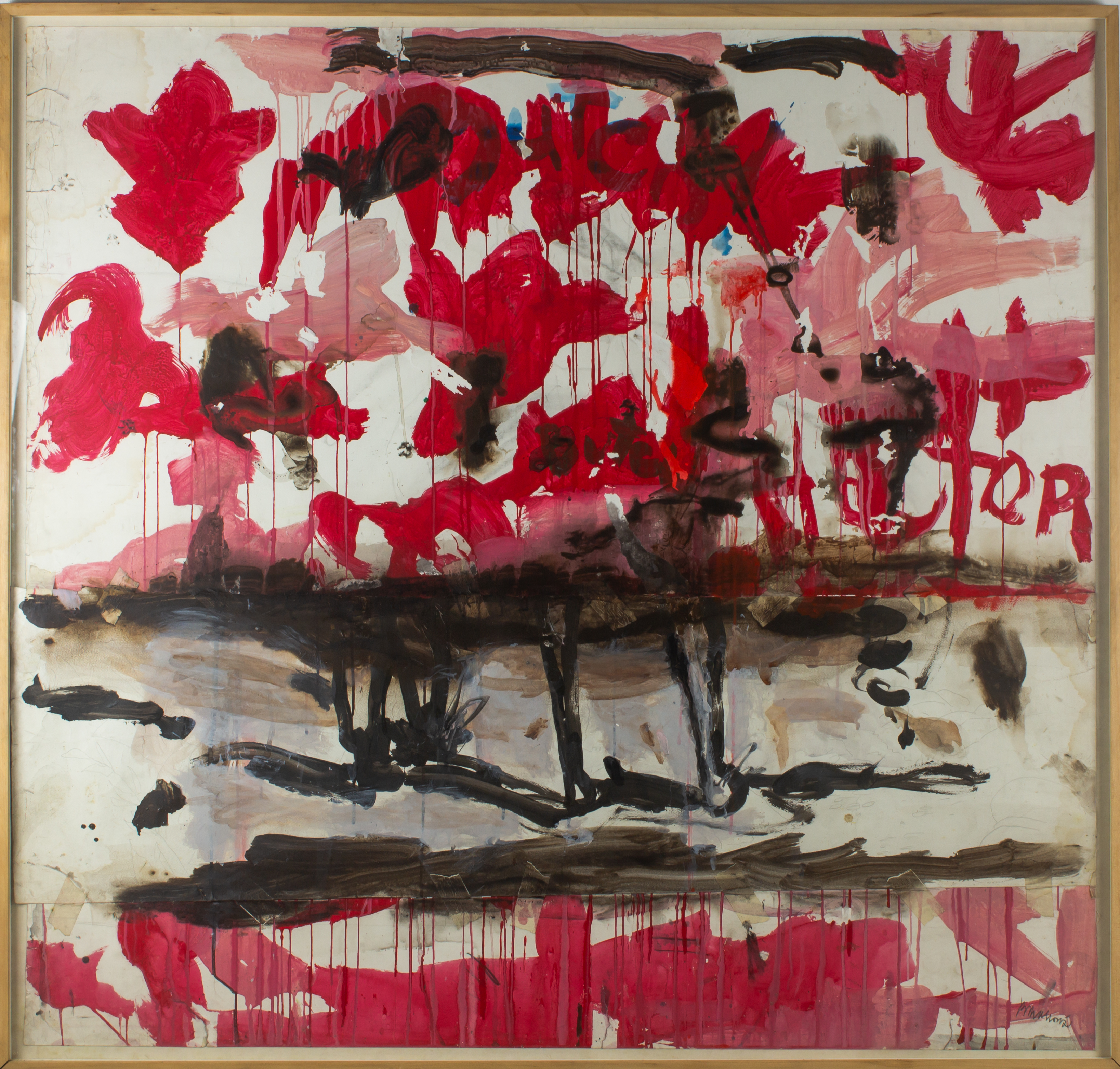
“Scratch to an Itch” is a catchphrase culled out by artist RM de Leon from collegial conversations. In his recollection, it was said to allude to the necessity of Modern painting at a point in time where theoretical and stylistic currents were changing course. Here, it is a perfect cover for a host of expressions, and the ideal allusion for a painter’s intrinsic compulsion to paint: the raison d’être of the artistic life. The congregated expressions in the exhibition is multifarious in range and sensibilities, but, the observed eclecticism has one center: painting is the proverbial muse and the undeniable phantom pain, albeit persisting as a plain and two-dimensional, flat object.
Painting’s history is a vast territory, and it is essential to pick a few turning points that lead to the artistic breakthroughs in the past millennium. Breaking out of its mold as a highly sophisticated tool for the making of mimetic pictures, it assumed the role of being its own entity - a tangible and malleable thing that increased in autonomy alongside the innovative designs of its progenitor-painter. Picasso’s 1912 collage/painting utilizing chair caning materials is a valuable case in point.
This outward-the-canvas trajectory culminates in Minimalism in the 1960s with the divesting of painting into austere object-hood that extends to sculpture and installation. Raising red flags, critical opinions saw the declared end of painting and art practitioners adamantly rallying to offer revivalist theories and practices. Visibly sprouting from the impasse were the “appropriative” Postmodernist styles espoused in architecture and industrial design, one of its proponents the celebrated figure Ettore Sottsass; and the pastiche-driven Trans-Avantguardia in America and Europe in the 1990s. These sought to transfuse new blood to painting.
This may very well be the backdrop of any contemporary practice. One may have a decided disregard for such canonical tracking, but, at this point, it is increasingly moot. Artistic reactions to this end-of-painting moment have evidently overcome the debacle. As art-making has become global and overlapping, bodies and entities providing judgements on aesthetics have moved away from the said Grand Narrative. Decentralized, art fractures constantly open to accommodate and further localized avenues of artistic learning and exploration. As such, seizing the moment, artists who have capitalized on such post-modernistic advances posit the inquiry: is it a return to modern painting or merely extending it?
This exhibition may well have found its backdrop in the aforementioned chronology of shifting upheavals, and the consolidation of its vertebrae must be traced to these momentous shifts. Curated by artist Raul Rodriguez, Scratch to An Itch comes after the heels of Brand X, an exhibition that could be seen as a sequel to the vaunted and well received exhibition Free Fall, that brought together artists with similar approaches and measurably unorthodox techniques.
Though it may pigeonhole a viewer’s response, providing a few broad strokes that describe each of the participating artists’ working attitudes might come in handy. Highlighting these noticeable operations provides a workable framework and consolidates the thesis of the exhibition. One of the perceived strategies that comes to fore is: the use of material as form and critique.